Powered By Blogger

Friday, June 24, 2011

Eastern Spain

     This is the Spain we love. And discovering it is even more fun. We have some visitors with us for this trip, Izzy's parents. We picked them up from the airport Friday morning and headed east to Barcelona. Our goal is to visit the provinces of northern Spain during the next two weeks and we've decided to start in Catalunya.
     Our first stop was in the small town Santa María de Huerta. We pulled in to see the Monastery advertised on the highway signs. The town is tiny and we arrived during the siesta so no one was about except the handful of people at a local cafe. We couldn't go in the Monastery because they too were on siesta and had closed the doors so we had to settle for walking around the courtyard. There we saw an old cemetery and met a drifter who was going to Zaragoza for work. He showed us his room and the bathroom and told us of how he was staying for the night in the Monastery until he could get on to Zaragoza. He later told us of how he believes the church is like the mafia. Interesting that he likes to bite the hand that feeds him. We bid him farewell and headed on to the Stone Monastery a few more miles down the road.
     We carefully mulled our decision of whether to pay the fee to enter the trail walk and monastery. Finally, Izzy's dad said they hadn't come this far not to see it so why the hell not. We agreed and went in. The walk through the forest is incredible. The first thing we noticed was the coolness in the forest, a much welcome break from the scorching heat of Spain's summer(over 100(that's 39 for you Celsius lovers) this weekend in Madrid). The forest here is dotted with streams and waterfalls and all kinds of rushing water. 
     We found waterfall...
     After waterfall...
     After waterfall...
     After waterfall in this place. And the sound of the rushing water is so relaxing. It got to me to wondering how a small oasis existed in this part of the country because the entire ride before and after, I stared at a landscape that looked like a desert planet out of a Star Wars movie.
     This part of the trail we didn't walk because we felt we'd put the old man through enough so we headed on to the Monastery. It was built over a 23 year period starting in 1185. The monks that lived there were some of the first in Europe to make chocolate. The lovely candy we enjoy today came from the Americas and was written about by Cortés when he conquered Mexico. Columbus brought it back and the friars at this Monastery began cooking and experimenting with different recipes of chocolate.
     There was also a large Wine Museum where we learned a lesson we keep learning in Europe. They don't hire the right people to translate important things and plugging things into a computer translator isn't the way to go. Because of this, we learned that "mosto" or grape juice becomes wine. Except they didn't translate it as such. The plaque read that must becomes wine. Oh well. We hope our generation of kids will learn better than their predecessors. There is an open air cathedral in the Monastery. The open air bit is mainly due to it falling apart but it adds a certain oneness with nature and faith that other churches just can't offer.
     We finally arrived in Barcelona late Friday night and spent the next day roaming around the city. Hope you enjoy the pictures.

Saturday, May 14, 2011

Milan, Italy

     One of the incredible things about visiting certain places in Europe is learning about just how much history they have. Milan is a contemporary city that is famous for its fashion scene and fashion weeks. The city itself has a history that dates back to the 4th century BC and a Celtic tribe called the Insubres. They were a mix of several tribes living in the area and they established the settlement of Milan. Two centuries later, they were incorporated into the kingdom of the Romans after failing to stop the advancements north. It eventually became the capital of the Western Roman Empire during the 3rd century AD. Again, two centuries later, another group conquered Milan and the surrounding area and they called it Lombardy, the name it has maintained up to modern day.
     We started our journey in Milan at the train station in the northern part of the city. We landed quite early and took a bus into the city. While we were having a coffee at a small stand outside the station, a couple of cops asked to see our paperwork. A friend later told us that the flood of immigrants from northern Africa has caused the police to start questioning most people standing around transport points like train stations. Afterwards, we wandered around to some of the hotels in search of a map. We found a nice girl at one of them who gave us a map and pointed us in the direction of the city center. We walked through the city and eventually found our hostel.
     We settled in and headed out to see the city. Our first stop was Il Duomo in the middle of the city. The Duomo sits on a huge plaza in the middle of the city. Off to the right is the Galleria Vittorio Emanuele II. It's named for the first king of Italy after the unification and was built in the late 19th century. The design and the paintings inside have a baroque feel and the sense of being there is overwhelming. One of the things we found to be odd and funny at the same time was the juxtaposition of certain shops. For instance, in the center there are four shops. Since the galleria is high end, its not strange to see Prada on one corner, Louis Vuitton on another, or a Mercedes store on the third. What's strange is that the fourth shop is a McDonald's. It sits in the space of one of the four premier shops in the galleria and shares a common space with some cafes that have been open since the 1860's.
     North of the Galleria is the famous La Scala Theater. It's Milan's famous Opera House and is regarded as one of the premier Opera House's in the world. It was constructed in the late 18th century after the previous theater burned down and a group of wealthy patrons who owned box seats asked the Archduke of Austria for a new one to be built. The current name was taken from the church that stood on the site but was torn down in order to build the new theater. It surprised us to learn that the theater serves as a place of gambling as well and this has caused problems with performers in the past. The top sitting area is famous for its intense fans who booed a performer off stage as recently as 2006.
     The most famous landmark in Milan is Il Duomo, or Milan Cathedral. The Cathedral took six centuries to build and is the fourth(or fifth depending on the source. Some cite the Cathedral in NYC as bigger) largest in the world. The first stone was laid in 1386 and construction of some form continued until 1965. The style is Gothic as most of the Cathedrals designed in the 14th and 15th centuries are. The construction was slow through the first couple of centuries due to the sheer size of the project and, with the kingdom of Milan changing hands, some people tried to change the designs. At one point, Carlo Borromeo tried to redesign the Cathedral so that it was more Renaissance like and Italian instead of Gothic, a foreign concept. In the 19th century, Napolean took over the kingdom of Italy and had the Cathedral nearly finished for his coronation ceremony that took place there in 1805. The inside is incredible and we spent a long time walking around. The stained glass windows have dozens and dozens of small pictures within the whole frame. As we were leaving, we saw a man leading the police to a strange bag he had found in the church. Apparently someone left some souvenirs behind.
     We spent Saturday afternoon wandering around with our friends Babak and Chiara. They took us down to the Porta Genova area to see a small canal that makes Milan look a bit like Venice. The area is full of small artisan shops and tons of people selling knick knacks and clothing from small stalls lining the canal. Some of the restaurants are quite old and traditional and have some really interesting areas around them like the area where women used to wash clothes.
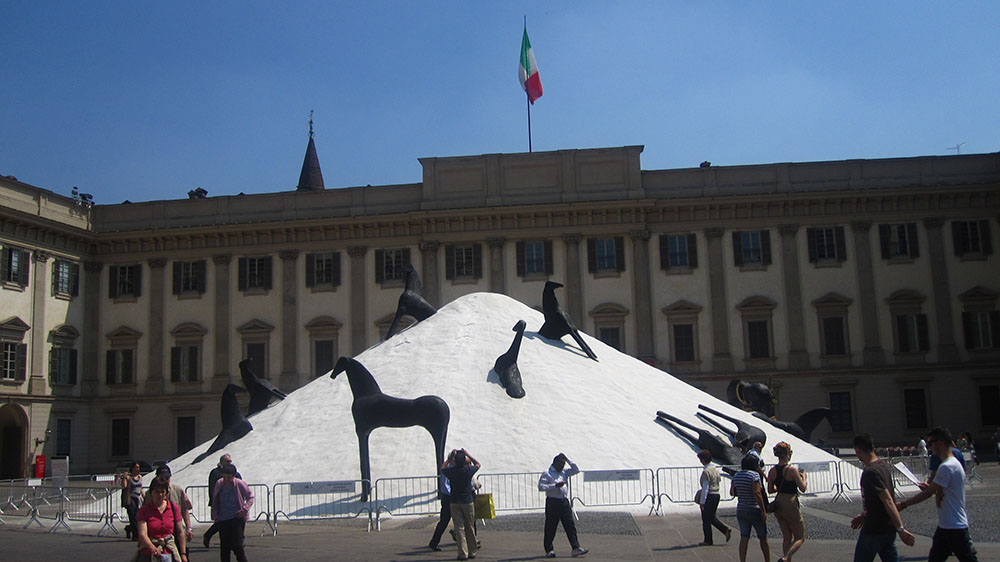
     On Sunday, we walked through the area of the Royal Palace. The palace is free to get into but as the line was long and we didn't have a lot of free time, we just walked around the courtyards and outside area. They had a large art exhibition out front and an old guy was walking through the area with his cat. It drove the little kids wild and they clamored to pet it. The Royal Palace once held high importance as a seat of government but now its a cultural center for the city. From the Duomo plaza, we walked up a pedestrian street lined with cafes and shops to the Sforzesco Castle. It was built in the 14th and 15th centuries and housed the Duchy of Milan. It has four large towers at the corners and what is left over of a moat that once provided protection. Behind the castle is Sempione Park, Milan's largest park in the city limits. We walked through it twice. There are some small cafes, sport courts for basketball and lots of paths with benches, lakes, and tons of open areas to sit and enjoy a beautiful day.
     Behind Sempione Park is the Peace Arch. It was started by Napoleon but after his defeat at Waterloo, the construction stopped until the emperor of Austria ordered it completed. It was dedicated to the peace treaty signed at Vienna in 1815. It looks like a smaller version of the Arc de Triomphe in Paris. The arch is an icon of Milan because Milan's famous fashion week is held there. Behind it are many of the bars that offer apertivi, a snack buffet available from 6-9 daily with a drink. We all ate dinner at one of the bars Saturday night and food was delicious. Overall, we had a great time and we hope that when we return in August, we might be able to get in line to the see the famous Last Supper painting at the Santa Maria delle Grazie Church. Apparently, you have to reserve a spot to see it up to two months in advance.